
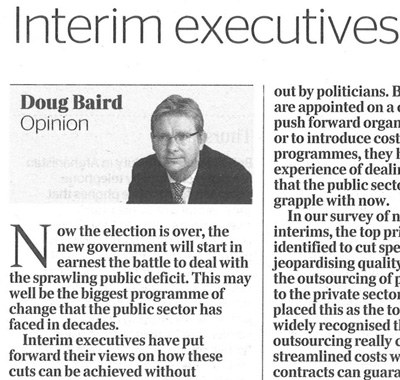
The following Interim Partners’ by-line article was submitted to The Times newspaper; it was published on 7 May 2010. The piece also generated coverage in the London Evening Standard, Recruiter Magazine, RecNews, Local Government Executive and BusinessDesk online.
Interim executives can be key to delicate balancing act
Now the election is over the new Government will start in earnest the battle to deal with the sprawling public deficit. This may well be the biggest programme of change the public sector has faced in decades.
Interim executives, the UK’s most experienced group of change managers and efficiency experts, have put forward their views on how these cuts can be achieved without jeopardising quality and their proposals challenge the approach set out by politicians.
Because interims are appointed on a contract basis to push forward organisational change or to introduce cost cutting programmes they have an unusually broad experience of dealing with exactly the issues that the public sector now needs to grapple with.
Having collectively run efficiency programmes across tens of thousands of public and private sector organisations, interims are definitely a constituency worth listening to.
In our survey of nearly 1,500 interims the top priority they identified to cut spending without jeopardising quality was to step up outsourcing of public sector work to the private sector. 30% identified outsourcing as the top priority.
Outsourcing to the private sector may not be a vote winner for the unions, but it is widely recognised that a well-executed outsourcing programme really can deliver streamlined costs whilst smart contractual drafting can guarantee service delivery.
While politicians have avoided talking about outsourcing, the stock market has been less reticent with the share prices of many outsourcers increasing in expectation of post election contracts.
The long-standing debate on targets was reignited during the election by calls to scrap targets altogether because public sector workers “game” the system to manipulate results. Interims actually identified more or tougher targets as the second most effective measure to cut costs. 21% of interims said more targets were important, while only 9% said that abolishing targets completely would work - the lowest ranking result. In the private sector the idea of scrapping targets would be seen as blue-sky thinking gone mad.
Cost overruns on high profile IT systems like ID cards have dampened appetite for the use of IT in the public sector to bring costs down by reducing headcount. But interims disagree, ranking investment in IT as the third most important measure for a new Government. 21% of those we talked to recognised the reduction that well implemented IT projects can bring to staffing costs.
The recent Ian Smith Review suggested relocating 15,000 Whitehall staff from the southeast to streamline costs but only one in ten interims thought this should be the priority because it can take so long to see the benefit.
Cutting the use of consultants and other contract workers has also been widely touted. However, most people recognise that in a modern economy it is a rational decision for any organisation to use external contractors and consultants who can bring the required skills to a particular project. When there is a risk of cost overruns, interims can be a cost effective way of managing consultants and making sure they provide value for money to the taxpayer.
The new Government has a big task ahead in balancing necessary cuts against effective delivery of important frontline services. Now that the debate on who is going to wield the axe is over let’s hope that some serious thinking takes place before the harder work of making the cuts begins.